Electric vehicles are becoming an important part of the changing transportation landscape. As EV adoption expands, the need for accessible and well-planned charging infrastructure is also increasing.
Charging stations are being developed across commercial properties, residential complexes, highways, offices, parking facilities and public spaces. Along with charging equipment and electrical infrastructure, these locations also require thoughtful planning for vehicle movement, user comfort and weather protection.
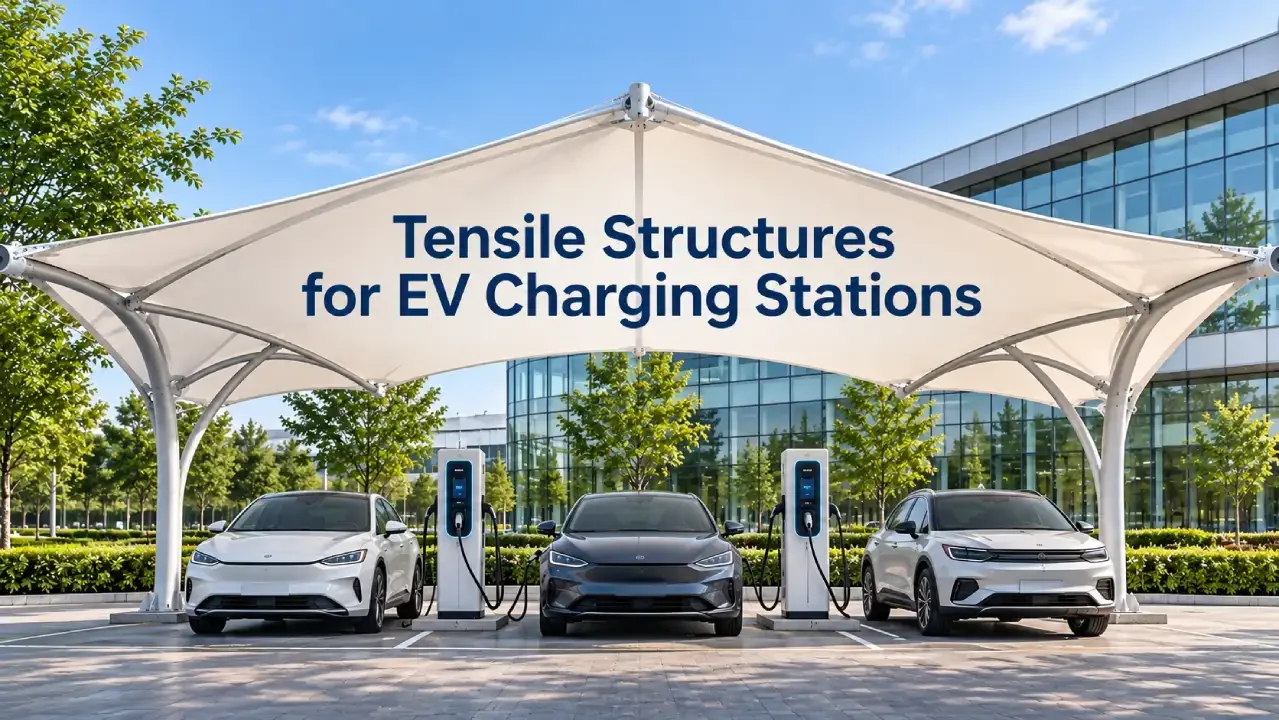
Tensile structures for EV charging stations can provide a practical canopy solution for covered charging bays. With flexible design possibilities and modern architectural appeal, tensile canopies can help create organised and functional charging environments.
In this guide, we explore how tensile structures can be used for EV charging facilities and the important factors to consider when planning a canopy.
Why Do EV Charging Stations Need Canopies?
EV charging equipment is commonly installed in outdoor or semi-outdoor locations. These areas may be exposed to direct sunlight, rain, dust and changing weather conditions.
A properly designed canopy can improve the usability of the charging area by providing overhead coverage for vehicles and users.
Some important considerations include:
Providing shade for parked vehicles.
Creating a more comfortable waiting and charging environment.
Defining individual charging bays.
Improving the overall appearance of the facility.
Organising covered parking and pedestrian movement.
Supporting a consistent architectural identity across multiple charging locations.
A canopy must not interfere with charging equipment, cable access, electrical clearances or emergency arrangements. These requirements should be addressed during the design stage.
How Tensile Structures Can Support EV Charging Infrastructure
Tensile structures use tensioned membrane materials supported by an engineered framework. Their geometry and support arrangement can be customised according to the available site and required coverage.
For EV charging facilities, tensile canopies can be planned around charging bays, vehicle dimensions, equipment locations and pedestrian access.
1. Flexible Canopy Layouts
EV charging locations differ in size and configuration. Some facilities have a few charging points, while others accommodate multiple vehicles.
Tensile canopies can be designed in different layouts to suit the number of charging bays and the available space.
2. Open and Accessible Design
A well-planned canopy can provide overhead coverage while maintaining the required movement space for vehicles and users.
Column positioning, vehicle turning areas, charging equipment and emergency access must be considered together.
3. Modern Architectural Appearance
The shape and finish of a tensile canopy can contribute to the visual identity of an EV charging facility.
Membrane colours, roof geometry and structural arrangements can be selected to complement the surrounding commercial or architectural environment.
4. Weather Protection
Suitable tensile membranes can provide shade and rain protection when designed with appropriate roof slopes, drainage and detailing.
The actual level of protection depends on membrane specifications, structural design, installation quality and local weather conditions.
Key Design Considerations for EV Charging Station Canopies
Planning a canopy for an EV charging station involves both architectural and technical requirements.
1. Charging Bay Dimensions
The canopy should provide suitable coverage for the intended vehicle types and parking arrangement. Designers must consider vehicle length, width, height and movement clearance.
2. Placement of Charging Equipment
Charging units, cables, electrical panels and other equipment need to remain accessible. The canopy framework should not obstruct operation, inspection or maintenance.
3. Electrical Safety
Electrical installations at EV charging facilities must follow applicable electrical safety requirements. The canopy design should coordinate with the electrical layout and maintain required clearances.
4. Wind Load and Structural Stability
The supporting framework, membrane, connections and foundations must be engineered for the site's environmental conditions. Wind exposure and roof geometry are particularly important considerations.
Read more about wind load analysis in tensile structures.
5. Rainwater Drainage
The roof shape should support effective rainwater drainage and avoid uncontrolled water discharge near charging equipment, pedestrian routes or vehicle access areas.
6. Lighting and Visibility
Charging areas should be adequately illuminated for safe movement and convenient use, particularly during evening and night-time operations.
7. Maintenance Access
The design should allow access for inspection and maintenance of the canopy, charging equipment, electrical systems and drainage components.
Can Tensile Canopies Be Used with Solar EV Charging Stations?
Solar-powered EV charging facilities combine renewable energy generation with electric vehicle charging infrastructure.
A canopy may be considered as part of a solar charging station, but the integration requires specific engineering.
Standard tensile fabric should not automatically be assumed suitable for supporting solar panels. The design must account for the weight of the panels, mounting arrangements, wind loads, electrical systems, waterproofing and maintenance access.
Depending on the project, solar panels may require a separately engineered supporting framework or a dedicated roof system.
The most suitable arrangement should be determined through coordination between structural, electrical and solar-system specialists.
Applications of Tensile Canopies in EV Infrastructure
Tensile canopies can be evaluated for different types of EV charging locations.
1. Commercial Charging Stations
Shopping centres, office complexes, hotels and commercial properties can incorporate covered EV charging bays into their parking areas.
2. Highway Charging Facilities
Highway charging locations require convenient vehicle access and adequate space for users. Canopies can provide overhead coverage for designated charging bays.
3. Residential Complexes
Housing societies and residential developments may require organised charging areas for residents and visitors. Canopy planning can be coordinated with the existing parking layout.
4. Corporate Campuses
Corporate offices and industrial campuses can integrate EV charging facilities into employee and visitor parking zones.
5. Fleet Charging Facilities
Businesses operating electric delivery vehicles, company cars and other fleet vehicles may require multiple charging points. Larger canopy arrangements can be evaluated according to vehicle movement and operational requirements.
For related parking applications, explore Arya Engineering's car parking tensile structures.
How to Plan an EV Charging Canopy Project
A successful canopy project begins with an assessment of the charging facility and its operational needs.
Step 1: Conduct a Site Assessment
Identify the available area, existing parking arrangement, access roads and surrounding infrastructure.
Step 2: Finalise the Charging Layout
Determine the number of charging bays, equipment positions, vehicle dimensions and pedestrian routes.
Step 3: Develop the Canopy Design
Select an appropriate roof geometry, structural arrangement, coverage area and membrane specification.
Step 4: Complete Engineering Calculations
Evaluate wind loads, structural members, connections, foundations, drainage and other relevant design requirements.
Step 5: Coordinate Electrical and Safety Requirements
Ensure the canopy design works with charging equipment, electrical installations, clearances and emergency access.
Step 6: Fabrication and Installation
Proceed with fabrication and installation according to the approved drawings and project requirements.
How Arya Engineering Supports Tensile Canopy Projects
Arya Engineering provides customised tensile structure solutions for commercial, industrial, educational and architectural applications.
Its range includes car parking shade structures and other tensile offerings that can be planned according to site requirements.
The company's completed project portfolio includes different types of parking shades, canopies and specialised structures.
For EV charging facilities, a canopy should be designed around the charging layout, vehicle access, electrical infrastructure and environmental conditions. A project-specific assessment helps establish the right coverage and structural arrangement.
Conclusion
As EV charging infrastructure continues to expand, the planning of charging locations will become increasingly important. Along with charging equipment and electrical systems, suitable overhead coverage can contribute to a more organised and user-friendly facility.
Tensile structures offer flexible design possibilities for EV charging canopies, combining functional coverage with modern architectural appeal. Their successful application depends on proper structural engineering, electrical coordination, drainage planning and safety compliance.
Arya Engineering offers customised tensile structure solutions for different commercial and infrastructure applications, helping project owners explore suitable canopy designs for their requirements.
Planning a tensile canopy for an EV charging facility?
Connect with Arya Engineering to discuss your project requirements.
📞 +91 9325383807
🌐 https://arya-engineering.in/
✉️ ho@arya-engineering.in
Frequently Asked Questions (FAQs)
1. What are tensile structures used for in EV charging stations?
Tensile structures can be used as overhead canopies for EV charging bays, providing shade and rain protection for vehicles and users.
2. Are tensile canopies suitable for outdoor EV charging stations?
They can be suitable when designed according to site conditions, structural requirements, electrical clearances and applicable safety standards.
3. Can tensile canopies cover multiple EV charging bays?
Yes. Their layout can be customised to cover multiple charging bays, depending on the available area, vehicle movement and structural design.
4. Can solar panels be installed on tensile EV charging canopies?
Solar panels can be integrated only when the complete roof and supporting system are specifically engineered for their weight, mounting requirements, wind loads and electrical connections. A standard fabric canopy should not be assumed suitable.
5. What factors affect the cost of an EV charging station canopy?
The cost depends on the covered area, membrane material, structural framework, foundation requirements, site conditions, drainage arrangements and installation complexity.
6. Do EV charging station canopies require maintenance?
Yes. Regular inspection of the membrane, framework, connections, foundations and drainage system helps maintain performance and identify issues.
7. Can tensile canopies be customised for different EV charging layouts?
Yes. The design can be developed according to the number of charging points, parking arrangement, vehicle dimensions and site requirements.